Three weeks. Five cities. One flight into the mountains of Yunnan and a slow journey back down through some of the most varied landscapes and urban environments China has to offer. March 2026 turned out to be one of the most photographically rewarding trips I've taken.
It started, as China trips often do, in Shenzhen.
Shenzhen — The Gateway
Shenzhen is a city that still surprises me every time I visit. What was farmland forty years ago is now one of the most dynamic urban environments on earth — a skyline that changes faster than you can photograph it, a metro system that puts most of Europe to shame, and a street level energy that never quite switches off.
A day trip across the border into Hong Kong added a familiar contrast — the trams on Des Voeux Road, the harbour from the Kowloon waterfront, the layered density of a city built vertically out of necessity. Hong Kong and Shenzhen sit twenty miles apart and feel like different worlds. Photographing both on the same trip makes that contrast impossible to ignore.
Into Yunnan — Lijiang
The flight from Shenzhen to Lijiang is one of the more dramatic arrivals in travel photography. The plane descends through cloud and suddenly the landscape below is no longer the flat coastal plain of Guangdong — it's mountains, ridges, river valleys cutting deep into the plateau. Yunnan announces itself from the air.
Lijiang old town is a UNESCO World Heritage Site and it earns the designation. A network of cobbled streets and wooden Naxi architecture threaded through by dozens of small canals, with Jade Dragon Snow Mountain visible on clear days above the rooftops. March brought a mix of bright mornings and overcast afternoons — the clear days gave sharp mountain backdrops while the overcast hours softened the old town into something quieter and more intimate, emptier of the crowds that pack the streets later in the year.
The surrounding countryside rewarded early starts — terraced fields catching the morning light, mountain villages where the Naxi culture feels genuinely living rather than performed for tourists, and roads that climbed into landscapes that felt completely remote despite being minutes from the old town.
Shangri-La — Altitude and Monastery
The journey from Lijiang to Shangri-La climbs steadily through pine forests and high grassland, the air thinning noticeably as the road rises above 3,000 metres. Shangri-La — officially Zhongdian, renamed to draw the tourists that have duly arrived — sits on a high plateau that feels genuinely other-worldly, particularly in changeable March weather when cloud and sun alternate across the grasslands every few minutes.
Songzanlin Monastery is the centrepiece — the largest Tibetan Buddhist monastery in Yunnan, a complex of golden-roofed buildings climbing a hillside above the town. Morning visits reward patience — monks going about their daily routines, prayer flags catching the wind, the low sun catching the monastery's upper levels while the lower town is still in shadow. The light here has a quality unique to high altitude — thinner air, sharper contrasts, colours that feel slightly more saturated than at sea level.
Dali — Pagodas and Old Walls
Dali sits between the Cangshan Mountains and the plain below, and that geography shapes everything about how it looks and feels. The old town is smaller and less visited than Lijiang, with a relaxed pace and a genuine local life operating alongside the tourist infrastructure rather than being replaced by it.
The Three Pagodas of Chongsheng Temple were the photographic centrepiece of the Dali days — three Tang Dynasty towers that have stood at the foot of the Cangshan Mountains for over a thousand years, reflected in the still waters of the pool in front of the temple complex. The largest pagoda rises sixteen storeys and dominates the skyline to the north of the old town. In the changeable March weather the scene shifted constantly — on overcast mornings the pagodas reflected softly in flat silver water, the mountains behind disappearing into low cloud. When the sun broke through the whole composition sharpened — strong shadows on the pagoda stonework, crisp mountain ridges above, the reflection in the pool suddenly vivid and detailed.
The Three Pagodas are one of those subjects that reward time and patience rather than a quick visit. The light changes the image entirely depending on the hour and the cloud, and staying long enough to see several different conditions produces a far more interesting set of photographs than arriving, shooting, and leaving.
The old town walls and the Bai architecture of the surrounding streets added an urban and cultural dimension — carved wooden doorways, whitewashed walls with decorative painted panels, the particular character of a minority culture that has maintained its identity despite centuries of change around it.
Chongqing — The City That Stopped Me in My Tracks
I'd been told Chongqing was worth a few days. I hadn't been prepared for quite how extraordinary it would be to photograph.
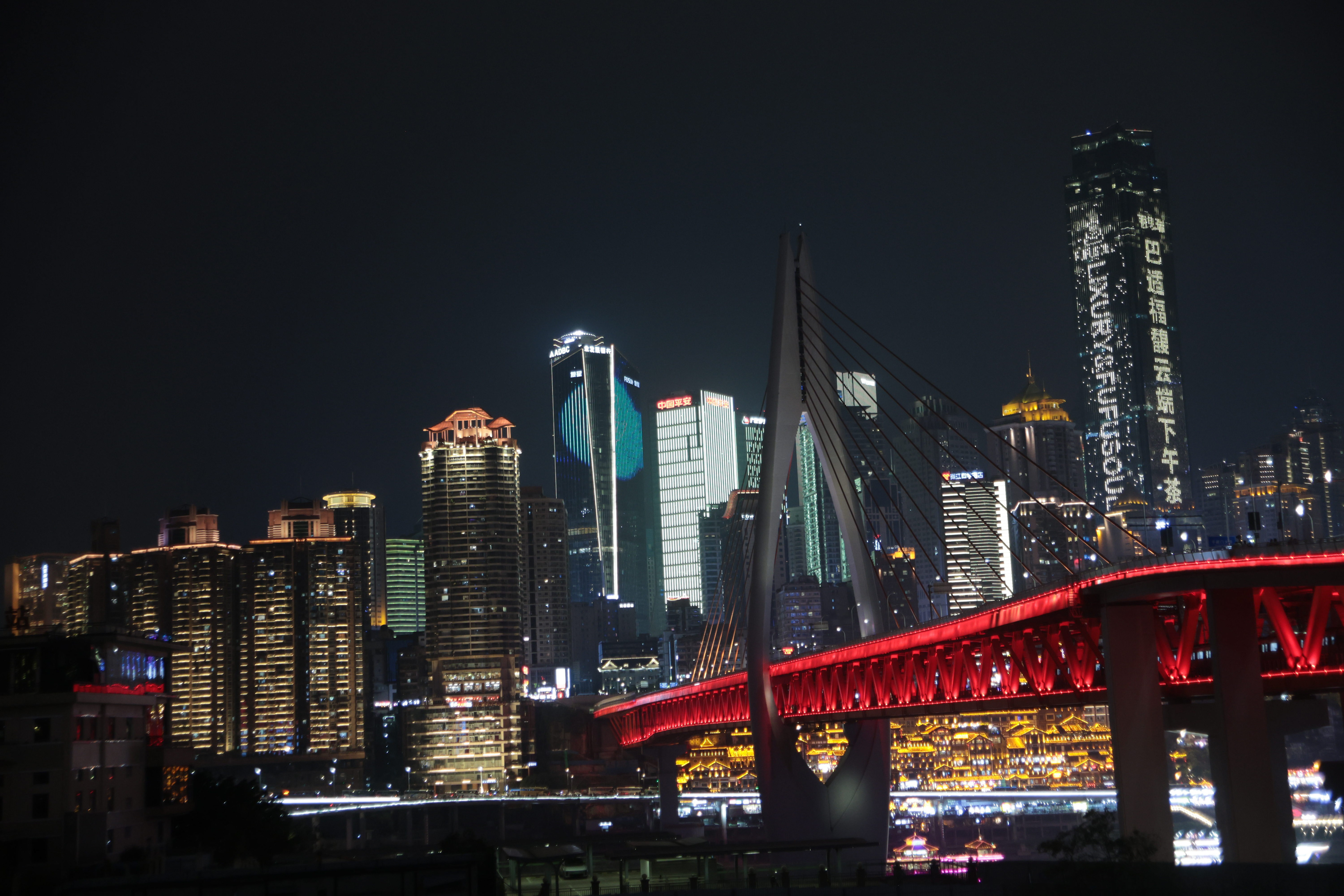
Built at the confluence of the Yangtze and Jialing rivers, on hills so steep that the city has essentially been constructed vertically — buildings climbing the ridges, cable cars crossing the gorges, elevated highways threading between tower blocks at the height of what would be the twentieth floor anywhere else. There is no flat ground in central Chongqing. Everything is either going up or coming down.
The riverside at night is among the most dramatic urban photography I've encountered anywhere in the world. Both rivers lined with illuminated skyscrapers reflected in the dark water, the hills behind adding layer after layer of light receding into the distance, boats moving slowly through the reflections. The scale is almost impossible to convey in a single frame — Chongqing at night demands sequences, panoramas, time spent simply standing and absorbing before raising the camera.
By day the city rewards walking — particularly the older hillside neighbourhoods of Hongyadong and the Eighteen Steps area, where traditional Chongqing life sits in the shadow of the new city rising around it. Street food, steep stone stairways, laundry strung between buildings, the constant sound of construction somewhere above or below. This is urban photography at its most layered and complex.
The weather in Chongqing lived up to its reputation — the city sits in a basin and traps humidity and cloud, giving it a naturally diffused light that flattens harsh shadows and suits street photography well. On the one clear evening I had, the riverside at golden hour was simply extraordinary.
I came to Chongqing not knowing what to expect and left visiting the deepest metro station 700 steps from entrance to platform, the ancient city and the waterfront at night with the neon lights
The Journey Back
The flight from Chongqing back to Shenzhen felt like a fitting final chapter — crossing above the karst landscapes of Guizhou and the river valleys of Guangdong, the sheer scale of southern China laid out below before the descent back into the sprawl of the Pearl River Delta.
Shenzhen again, briefly. Then the long flight home.
Three weeks, five cities, and a memory card full of images that are going to take a long time to work through properly. Yunnan delivered everything I'd hoped for. Chongqing delivered everything I hadn't expected. That's the best kind of trip.